Boy's surface is an immersion of the real projective plane in 3-dimensional space found by Werner Boy in 1901 . He discovered it on assignment from David Hilbert to prove that the projective plane could not be immersed in 3-space .
To make a Boy's surface:
1. Start with a sphere. Remove a cap.
2. Attach one end of each of three strips to alternate sixths of the edge left by removing the cap.
3. Bend each strip and attach the other end of each strip to the sixth opposite the first end, so that the inside of the sphere at one end is connected to the outside at the other. Make the strips skirt the middle rather than go through it.
4. Join the loose edges of the strips. The joins intersect the strips.
Boy's surface can be used in sphere eversion, as a half-way model. A half-way model is an immersion of the sphere with the property that a rotation interchanges inside and outside, and so can be employed to evert (turn inside-out) a sphere. Boy's surface is the beginning of a sequence of half-way models with higher symmetry first proposed by George Francis.
Boy's surface ( Trivia # 22 )
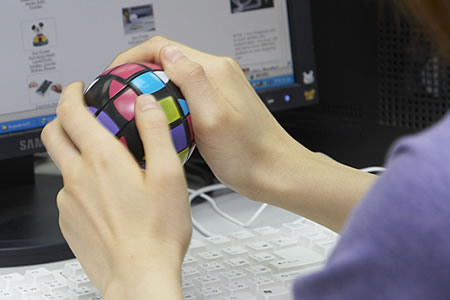
on Friday, May 29, 2009If Rubik’s Cube Was a Ball ? ( Trivia # 20 )
on Friday, May 15, 2009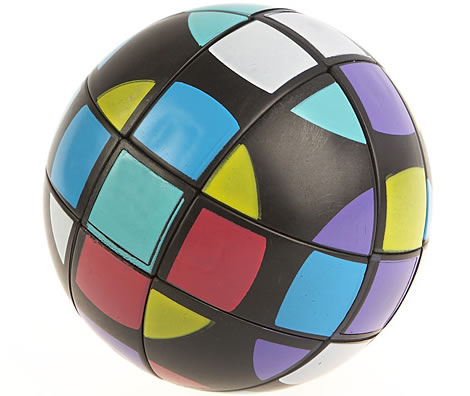
If you took the classic Rubik’s Cube mechanical puzzle and changed it into the shape of a ball, you’d get something that looked much like this.
Königsberg Bridge Problem ( Trivia # 16 )
on Wednesday, May 6, 2009The Konigsberg Bridge problem is perhaps the best known example in the graph theory. It was a long-standing problem until solved by Leonhard euler in 1736, by means of a graph. The problem is depicted in the pictures given below.

Fig. 2

Two islands , C and D, formed by the Pregel River in Konigsberg were connected to each other and to the banks A and B with seven bridges, as shown. The problem was to start at any of the four land areas of the city , A , B , C , or D, walk over each of the seven bridges exactly once, and return to the starting point ( without swimming across the river, of course :D ).
U can now see this situation by means of a graph, as shown in the figure below. The vertices represent the land areas and the edges represent the bridges.

Before dealing with this problem let us generalize this problem .... as proposed by the Euler Graphs
def : If some closed path in a graph passes through all the vertices , then this path is called an Euler line and the graph an Euler graph . Thus an Euler Graph has no isolated vertex and all vertices form an interconnected network ...
Another important property of an Euler Graph is that all the vertices are of even degree ?? Puzzled ....
Since it is an Euler Graph it contains an Euler line(the closed path). In tracing this line we observe that every time it meets a vertex 'x' two lines are created .. one "entering" that vertex and another "leaving" the vertex . This is not only true for all intermediate vertices but also for the terminal vertex (because we "entered" and "exited" this vertex at the begining and end) . This proves that the degree (no. of lines radiating from a vertex) of every vertex is even .
 Thus for finding the solution to the Konigsberg bridge we need to check whether its graphical representation is an Euler Graph .... U can check urself that its vertices are not having even degree .Thus it is not possible to walk over each of the seven bridges exactly once and return to the starting point . Hence the Konigsberg Bridge problem possesses no solution .
Another variation of this kind of problem is mentioned below ...... u might have tried it when u were a kid ...
Without lifting the pencil draw this figure without passing through the same line or curve twice ..

I made another version of this Konigsberg Bridge .... try this too ... and post ur solution in comments ...
Mahato Ka Bridge :)

Double Pendulum ( Trivia # 15 )
on Saturday, May 2, 2009A double pendulum is a pendulum with another pendulum attached to its end, and is a simple physical system that exhibits rich dynamic behavior. The motion of a double pendulum is governed by a set of coupled ordinary differential equations. The double pendulum undergoes chaotic motion, and shows a sensitive dependence on initial conditions.
The lack of a natural excitation frequency has led to the use of double pendulum systems in seismic resistance designs in buildings, where the building itself is the primary inverted pendulum, and a secondary mass is connected to complete the double pendulum.
Don't think much about what i wrote in the previous paragraph ... this pendulum is seldom used for any purpose ... but u will really appreciate their random motion !!
View of Double Pendulum from top

Double Pendulum in action

Möbius strip ( Trivia # 9 )
on Wednesday, April 29, 2009The Möbius strip or Möbius band is a surface with only one side and only one boundary component. The Möbius strip has the mathematical property of being non-orientable. It is also a ruled surface. It was discovered independently by the German mathematicians August Ferdinand Möbius and Johann Benedict Listing in 1858.
A model can easily be created by taking a paper strip and giving it a half-twist, and then joining the ends of the strip together to form a loop. In Euclidean space there are in fact two types of Möbius strips depending on the direction of the half-twist: clockwise and counterclockwise. The Möbius strip is therefore chiral, which is to say that it has "handedness" (as in right-handed or left-handed).

Binary Clock ( Trivia # 8 )
on Tuesday, April 28, 2009Catch out this amazing variety of clock ....
As of 2008, the most common binary clocks sold are designed by Anelace Inc., and uses six columns of LEDs to represent zeros and ones. Each column represents a single decimal digit, a format known as binary-coded decimal (BCD). The bottom row in each column represents 1 (or 20), with each row above representing higher powers of two, up to 2^3 (or 8). To read each individual digit in the time, the user adds the values that each illuminated LED represents, then reads these from left to right. The first two columns represent the hour, the next two represent the minute and the last two represent the second. Since zero digits are not illuminated, this clock is not usable in the dark.
To read a BCD clock add the values of each column of LEDs to get six decimal digits. This gives two decimal digits each for hours, minutes, and seconds.
Pythagoras Tree (Trivia # 2)
on Sunday, April 26, 2009The Pythagoras tree is a plane fractal constructed from squares. It is named after Pythagoras because each triple of touching squares encloses a right triangle, in a configuration traditionally used to depict the Pythagorean theorem. From the left each image is an iteration of this function growing exponentially more complex. The top is a 45,45,90 triangle and the bottom is a 30, 60, 90 triangle resulting in a lopsided tree.

Pythagoras tree

If we add a third dimension by making the squares into cubes and exploring the geometry in 3 dimensional space we get a Dragon Curve. The cubes were rendered 95% transparent so you can see the geometry inside of it.
Pythagoras Dragon Curve

Hi everyone ,
We all know that time is the most important thing in our life . But have you ever wondered that the thing which keeps a count of it can sometimes be very intresting .
Check these amazing clocks ...


